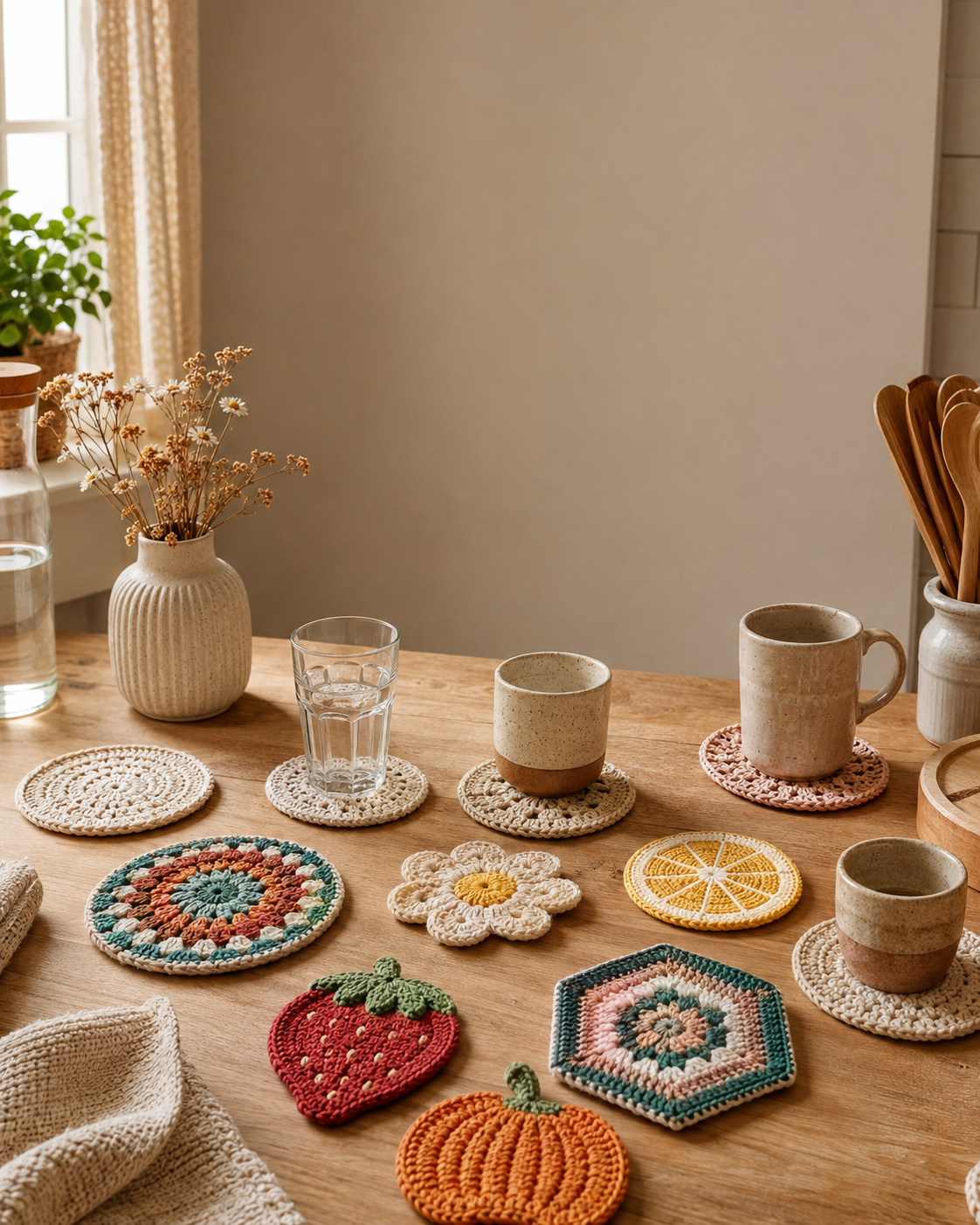
Crochet coasters are one of the easiest ways to bring handmade charm into your kitchen without taking on a large or complicated crochet project.
They are small, practical, inexpensive to make, and perfect for using leftover yarn. A simple round coaster can become a colorful mandala, a flower, a strawberry, a cat, a pumpkin, a geometric design, or a seasonal decoration simply by changing the colors, stitches, shape, or border.
Whether you are completely new to crochet or already have a basket full of yarn waiting for its next project, these 27 crochet coaster ideas offer plenty of inspiration for creating beautiful handmade kitchen accessories.
In this guide, you’ll discover:
- 27 crochet coaster ideas
- Beginner-friendly designs
- Crochet coaster pattern inspiration
- A complete simple round coaster pattern
- Step-by-step instructions
- Crochet stitch abbreviations
- Yarn and hook recommendations
- Crochet coaster size guide
- Color combinations
- Tips for keeping coasters flat
- Ideas for seasonal crochet coasters
- Kitchen styling ideas
- Handmade gift ideas
- Washing and care tips
- A beginner YouTube video tutorial
Table of Contents
- Why Crochet Coasters Are Perfect for the Kitchen
- What Makes a Good Crochet Coaster?
- 27 Crochet Coaster Ideas
- Beginner Crochet Coaster Pattern
- Materials You’ll Need
- Crochet Abbreviations
- Step-by-Step Crochet Coaster Tutorial
- How to Keep a Crochet Coaster Flat
- How to Add a Decorative Border
- How to Change Colors
- Crochet Coaster Size Guide
- Best Yarn for Crochet Coasters
- Best Crochet Stitches for Coasters
- Crochet Coaster Color Palettes
- How to Create a Matching Kitchen Set
- Crochet Coasters for Gifts
- How to Wash Crochet Coasters
- YouTube Crochet Coaster Tutorial
- Frequently Asked Questions
- Final Thoughts
Why Crochet Coasters Are Perfect for the Kitchen
Small handmade details can make a kitchen feel much more personal.
Crochet coasters are especially useful because they combine decoration and function. They can sit underneath mugs, glasses, teacups and small dishes while adding texture and color to your table.
They are also one of the best small crochet projects for beginners.
A large blanket may take weeks or months to finish, while a simple coaster can be completed much faster. That makes coasters useful for practicing basic crochet techniques without committing to a huge project.
They are also perfect for using leftover yarn.
If you have several small balls of cotton yarn left from previous projects, you can combine them into a colorful set instead of letting them sit unused in your craft basket.
Crochet coasters are great for:
- Everyday kitchen use
- Coffee stations
- Dining tables
- Breakfast tables
- Holiday decorating
- Handmade gifts
- Housewarming gifts
- Craft fairs
- Small crochet businesses
- Using leftover yarn
- Practicing crochet stitches
What Makes a Good Crochet Coaster?
Before choosing a pattern, think about how you actually plan to use the coaster.
A decorative coaster can be delicate and lacy, while an everyday kitchen coaster should ideally be sturdy and relatively dense.
A good everyday crochet coaster should be:
- Flat
- Stable
- Easy to clean
- Large enough for a mug or glass
- Strong enough to keep its shape
- Comfortable to handle
- Finished neatly around the edges
For kitchen projects, cotton yarn is a particularly practical choice because it is durable and commonly available in washable varieties. For example, Yarnspirations’ beginner coaster project uses 100% cotton yarn and a 5 mm hook.
27 Crochet Coaster Ideas, Patterns & Designs
1. Classic Round Crochet Coasters
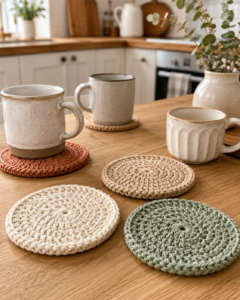
The classic round coaster is the perfect starting point if you are learning how to crochet.
The construction is simple: begin in the center and gradually increase stitches as you work outward.
You can make the entire coaster in one color or create stripes by changing colors after every round.
For a modern kitchen, try cream, beige, sage or warm gray.
For a colorful kitchen, combine pink, orange, yellow, turquoise and purple.
Why you’ll love this design
- Beginner-friendly
- Quick to make
- Uses little yarn
- Easy to customize
- Works with many stitch patterns
Best for: Beginners and everyday kitchen decor.
2. Colorful Mandala Crochet Coasters
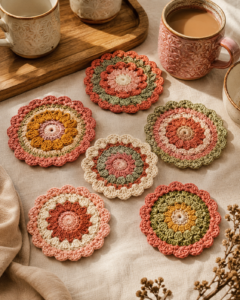
If you want something more decorative, mandala coasters are an excellent choice.
The circular shape makes them perfect for creating concentric rings of color.
You can change colors every round to create a rainbow effect or use a limited palette for a more sophisticated look.
Try:
Pink + coral + cream + mustard
or
Sage + terracotta + beige + rust
or
Lavender + lilac + white + dusty pink
Mandala coasters also look beautiful when displayed together on a serving tray.
3. Crochet Flower Coasters
Flower coasters bring a soft, handmade feeling to the kitchen.
Start with a circular center and add petals around the outside.
You can create:
- Five-petal flowers
- Six-petal flowers
- Layered flowers
- Small daisies
- Large decorative flowers
Pastel colors work especially well for spring and cottagecore decor.
Try: blush pink petals with a cream center and sage-green accents.
4. Sunflower Crochet Coasters
Sunflower coasters are perfect for warm rustic kitchens.
Use a dark brown center and golden yellow petals.
For a more modern interpretation, replace bright yellow with mustard.
These coasters look particularly beautiful during late summer and fall.
Styling idea
Place four sunflower coasters around a wooden table with cream ceramic mugs and a small vase of dried flowers.
5. Crochet Cat Coasters
Cat coasters are a fun way to personalize your kitchen.
The basic idea is simple: create a circular or slightly oval base and add two ears to the top.
Then embroider:
- Eyes
- Nose
- Whiskers
- Mouth
Make several different cats using different colors.
Cute set idea
- Black cat
- Orange cat
- White cat
- Gray cat
This would make an adorable handmade gift for a cat lover.
6. Crochet Bunny Coasters
Bunny coasters are perfect for spring and Easter decorating.
Use soft pastel yarn and create long ears from the upper portion of the coaster.
Color ideas
- Cream + pink
- White + lavender
- Beige + sage
- Blush + cream
For a more minimalist look, make the entire bunny cream and use only a tiny amount of pink for the ears and nose.
7. Strawberry Crochet Coasters
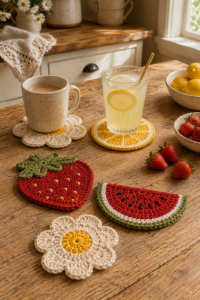
Strawberry crochet is perfect for a cottagecore-inspired kitchen.
Create a red or pink berry shape and add a green leafy top.
Tiny embroidered stitches can imitate strawberry seeds.
Complete the theme
Pair your strawberry coasters with:
- Strawberry potholders
- A crochet fruit basket
- Strawberry mug cozies
- Red-and-white kitchen textiles
This can turn a simple coaster into part of a complete kitchen collection.
8. Lemon Slice Crochet Coasters
Bright lemon coasters are perfect for summer.
Create a yellow circular base and use white stitches to imitate the sections of a lemon.
Add a small green leaf for an extra decorative detail.
These look especially nice beside a lemonade pitcher or iced tea glasses.
9. Watermelon Crochet Coasters
Create a watermelon using four basic colors:
Green + white + red + black
The green becomes the outer rind, white creates the transition, and red forms the fruit.
Add small black embroidered seeds across the red section.
This is a fun project for summer parties and outdoor dining.
10. Crochet Orange Slice Coasters
Orange-slice coasters are another colorful fruit-inspired option.
Use orange yarn for the main section and cream or white yarn for the segments.
You can make a full circular slice or experiment with a half-slice design.
Best for:
- Summer kitchens
- Brunch tables
- Fruit-themed decor
- Bright colorful kitchens
11. Granny Square Crochet Coasters
A small granny square can easily become a coaster.
This is a particularly good project if you already enjoy granny-square crochet.
Make the center one color, then add contrasting rounds.
Try:
Cream + sage + terracotta
or
Pink + red + cream
or
Blue + white + turquoise
Finish with a simple border to give the coaster a clean shape.
12. Hexagon Crochet Coasters
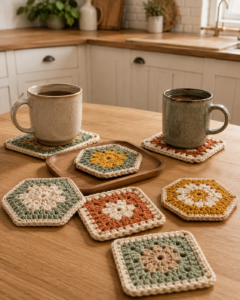
Hexagonal coasters are perfect if you want something different from the usual circle.
Their geometric shape creates an interesting arrangement when several coasters are placed together.
Make each hexagon a different color while keeping the same border color.
This creates a coordinated set without making every coaster identical.
13. Heart Crochet Coasters
Heart-shaped coasters work beautifully for romantic and seasonal decorating.
They are especially appropriate for:
- Valentine’s Day
- Mother’s Day
- Wedding gifts
- Anniversary gifts
- Bridal showers
Instead of bright red, try burgundy, dusty rose, cream or blush for a more sophisticated look.
14. Pumpkin Crochet Coasters
Pumpkin coasters are perfect for fall kitchen decorating.
Use orange yarn for the pumpkin and green or brown yarn for the stem.
You can create raised vertical lines to make the pumpkin look more dimensional.
Fall color palette
- Pumpkin orange
- Rust
- Mustard
- Cream
- Olive green
- Brown
15. Halloween Crochet Coasters
Halloween gives you dozens of possibilities.
Try making:
- Ghosts
- Bats
- Black cats
- Pumpkins
- Spiderwebs
- Spiders
- Skulls
A black, orange and cream palette makes even simple designs immediately recognizable as Halloween decor.
16. Christmas Crochet Coasters
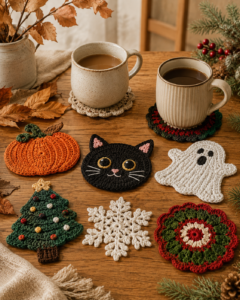
Crochet Christmas coasters can become part of your holiday table setting.
Popular designs include:
- Snowflakes
- Christmas trees
- Stars
- Holly leaves
- Candy canes
- Snowmen
For a traditional look, use:
Forest green + burgundy + cream + white
For a softer Scandinavian style, use:
Cream + beige + sage + muted red
17. Sunburst Crochet Coasters
A sunburst pattern radiates outward from the center.
The design can be made with different colors or simply created with textured stitches.
Mustard, orange, rust and cream make a beautiful warm palette.
This style works particularly well with rustic and bohemian kitchens.
18. Black and White Geometric Coasters
You don’t always need lots of colors to make crochet interesting.
Black and white can create sophisticated patterns such as:
- Checkerboards
- Diamonds
- Stripes
- Squares
- Circles
- Abstract designs
These are ideal for contemporary kitchens where colorful crochet might feel too busy.
19. Spiral Crochet Coasters
Spiral coasters create a dynamic pattern that immediately draws attention.
Use two contrasting colors so the spiral is easy to see.
Good combinations:
- Cream + terracotta
- Black + white
- Sage + cream
- Pink + burgundy
- Blue + white
20. Ripple Crochet Coasters
Ripple crochet produces a subtle wave pattern.
Instead of a perfectly smooth circular edge, the coaster has small rises and dips.
This is especially attractive when two colors alternate across the rounds.
A blue-and-white ripple coaster would be beautiful in a coastal kitchen.
21. Flower Mandala Coasters
Combine the beauty of a flower with the structure of a mandala.
Start with a small center and build outward using petal shapes and decorative stitches.
Use a different color for each round or keep the entire flower in one shade.
These are ideal when you want your coasters to look more like decorative mini artworks.
22. Basket-Weave Crochet Coasters
Basket-weave stitches create a thicker, highly textured fabric.
The texture makes the coaster look substantial and handmade.
Neutral shades work particularly well:
- Oatmeal
- Cream
- Beige
- Taupe
- Brown
These would look beautiful with wooden trays and ceramic kitchenware.
23. Minimalist Neutral Crochet Coasters
If your kitchen already contains lots of colors, keep your coasters simple.
Choose one neutral shade and create a clean circular shape.
Beautiful neutral options:
- Ivory
- Oatmeal
- Beige
- Taupe
- Warm gray
- Sage
Add a narrow contrasting border if you want a little extra detail.
24. Boho Crochet Coasters
Boho crochet works beautifully with earthy colors and textured stitches.
Try:
Terracotta + mustard + olive + cream
You can also add decorative edging or small fringe details.
Pair them with wood, woven baskets, linen and ceramic pieces to create a cohesive boho kitchen.
25. Coffee-Themed Crochet Coasters
Create a set specifically for your coffee station.
Ideas include:
- Coffee cups
- Coffee beans
- Mugs
- Brown-and-cream circles
- Coffee-inspired lettering
Place the finished coasters beside your coffee maker with a handmade mug cozy and a small wooden tray.
26. Paw Print Crochet Coasters
Paw-print coasters are a fun option for pet lovers.
Create one large central paw pad and four smaller toe pads.
Use contrasting colors so the shape stands out.
A set of four different paw colors can make a charming housewarming or pet-lover gift.
27. Mix-and-Match Crochet Coaster Sets
You don’t have to make every coaster identical.
Instead, create a coordinated collection of four different designs.
Cottagecore set
- Strawberry
- Flower
- Lemon
- Pink mandala
Modern set
- Black-and-white geometric
- Cream circle
- Gray hexagon
- Minimalist spiral
Fall set
- Pumpkin
- Sunflower
- Rust mandala
- Leaf
Halloween set
- Ghost
- Bat
- Pumpkin
- Spiderweb
The key is to keep one element consistent, such as the color palette, border or yarn.
Easy Crochet Coaster Pattern for Beginners
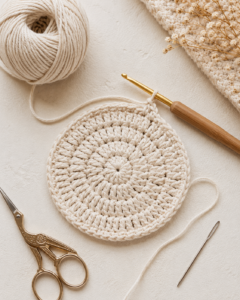
Now that you’ve seen the different possibilities, let’s make a simple coaster from scratch.
This pattern is intentionally straightforward so that a beginner can practice the basic techniques needed for many circular crochet projects.
Skill Level
Beginner
Finished Size
Approximately 4–5 inches (10–13 cm) depending on your yarn, hook and tension.
Construction
The coaster is worked in joined rounds from the center outward.
Materials You’ll Need
Yarn
Use a smooth medium-weight cotton yarn.
Cotton is particularly useful for kitchen projects because it is durable and many cotton yarns are washable.
Crochet Hook
A 4.0–5.0 mm crochet hook is a good starting range for medium-weight cotton yarn.
Always check the yarn label and adjust your hook if necessary.
Additional Materials
- Scissors
- Yarn needle
- Stitch marker
- Measuring tape
Crochet Abbreviations
The following instructions use US crochet terminology.
| Abbreviation | Meaning |
|---|---|
| ch | Chain |
| sc | Single crochet |
| sl st | Slip stitch |
| inc | Increase |
| st | Stitch |
| sts | Stitches |
| rnd | Round |
Beginner Crochet Coaster Pattern
Round 1
Make a magic ring.
Work 6 sc into the magic ring.
Pull the center closed.
Join with a slip stitch.
Total: 6 stitches
Round 2
Chain 1.
Work 2 sc into every stitch around.
Join with a slip stitch.
Total: 12 stitches
Round 3
Chain 1.
Repeat:
1 sc in the next stitch, 2 sc in the next stitch
Continue around.
Join with a slip stitch.
Total: 18 stitches
Round 4
Chain 1.
Repeat:
1 sc in each of the next 2 stitches, 2 sc in the next stitch
Continue around.
Join with a slip stitch.
Total: 24 stitches
Round 5
Chain 1.
Repeat:
1 sc in each of the next 3 stitches, 2 sc in the next stitch
Continue around.
Join with a slip stitch.
Total: 30 stitches
Round 6
Chain 1.
Repeat:
1 sc in each of the next 4 stitches, 2 sc in the next stitch
Continue around.
Join with a slip stitch.
Total: 36 stitches
Round 7
Chain 1.
Repeat:
1 sc in each of the next 5 stitches, 2 sc in the next stitch
Continue around.
Join with a slip stitch.
Total: 42 stitches
At this point, check the size.
If the coaster is already approximately 4–5 inches wide and lies flat, you can finish.
If you want a larger coaster, you can continue increasing evenly for another round.
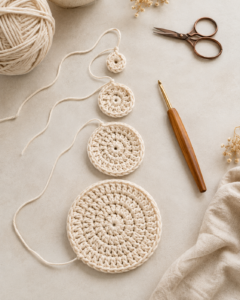
Quick Stitch Count Guide
| Round | Pattern | Stitch Count |
|---|---|---|
| 1 | 6 sc | 6 |
| 2 | 2 sc in each stitch | 12 |
| 3 | sc, inc | 18 |
| 4 | 2 sc, inc | 24 |
| 5 | 3 sc, inc | 30 |
| 6 | 4 sc, inc | 36 |
| 7 | 5 sc, inc | 42 |
Important: Your exact finished size may differ because crochet tension, yarn thickness and hook size all affect the final dimensions.
How to Know When Your Coaster Is the Right Size
Don’t rely only on the number of rounds.
Take a measuring tape and check the diameter.
For a standard mug or glass, around 4–5 inches is a practical target.
If you want to use the coaster underneath a larger mug, bowl or decorative container, make it larger.
How to Add a Simple Border
A border can make a basic coaster look much more finished.
Once your final round is complete, choose a contrasting color.
Attach the yarn and work a round of single crochet evenly around the edge.
For example:
Cream coaster + sage border
or
Pink coaster + red border
or
Rust coaster + cream border
A simple border is often enough to turn a basic beginner project into something that looks professionally finished.
How to Make a Scalloped Border
If you want something more decorative, try a scalloped edge.
A basic scalloped border can be created by working a small group of taller stitches into selected stitches around the outside edge.
Keep the spacing consistent so the scallops appear evenly distributed.
This type of border works especially well for:
- Flower coasters
- Cottagecore designs
- Baby-themed colors
- Valentine’s Day coasters
- Vintage-inspired kitchen decor
How to Change Colors
Color changes can completely transform the same pattern.
You don’t need a new pattern every time.
Simply use the same circular construction and change the color arrangement.
Two-color design
Round 1–3: Cream
Round 4–7: Sage
Rainbow design
Change color every round.
Strawberry palette
Pink + red + cream + green
Fall palette
Rust + mustard + cream + brown
Halloween palette
Black + orange + cream + plum
Christmas palette
Burgundy + forest green + cream
How to Keep Your Crochet Coaster Flat
This is one of the most important skills when making circular crochet projects.
If the coaster curls upward
Your circle probably needs more increases.
The fabric is not expanding quickly enough.
Try:
Adding increases more frequently.
If the coaster becomes wavy
You may have too many increases.
Try:
Reducing the number of increases or checking that you are following the stitch count correctly.
If the center is puckering
Your starting ring may be too tight or your tension may be too firm.
Try relaxing your tension slightly.
If the coaster is too loose
Try a smaller hook or a denser stitch.
Best Crochet Stitches for Coasters
Different stitches create very different results.
Single Crochet
Excellent for dense, sturdy coasters.
Best for: Everyday kitchen use.
Half Double Crochet
Creates a slightly taller fabric while remaining relatively compact.
Best for: Quick round coasters.
Double Crochet
Creates a more open fabric.
Best for: Decorative designs.
Slip Stitch
Useful for borders and finishing.
Granny Clusters
Perfect for colorful granny-square coasters.
Basket-Weave Stitches
Excellent for thick, textured designs.
Ripple Stitches
Great for colorful wave patterns.
Best Yarn for Crochet Coasters
Cotton Yarn
For most kitchen coasters, cotton is the first option I’d consider.
It is available in many colors, has good stitch definition and is commonly used for washable kitchen projects.
Cotton Blend
A useful alternative when you want a different texture or fiber combination.
Acrylic
Can be useful for decorative projects, but if your priority is a practical kitchen coaster, cotton is generally the more natural choice.
Wool
Beautiful for certain decorative designs, but care requirements can be more complicated.
Crochet Coaster Size Guide
| Type | Approximate Diameter | Best Use |
|---|---|---|
| Small | 3–4 in | Espresso cups |
| Standard | 4–5 in | Mugs and glasses |
| Large | 5–6 in | Large mugs or bowls |
| Extra Large | 6+ in | Decorative mats |
There is no universal perfect size.
The best size is the one that comfortably supports the item you want to place on top.
Crochet Coaster Color Combinations
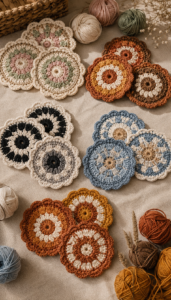
Choosing the right colors can make a simple pattern look completely different.
Soft Cottagecore
Cream + blush + sage + dusty lavender
Rustic Farmhouse
Terracotta + beige + olive + brown
Modern Minimalist
Black + white + warm gray
Coastal
Cream + sky blue + turquoise + sand
Fall
Rust + mustard + cream + brown
Halloween
Black + orange + plum + cream
Christmas
Forest green + burgundy + cream + white
Strawberry Kitchen
Pink + red + cream + green
How to Create a Coordinated Crochet Kitchen
Your coasters don’t have to exist on their own.
Once you’ve chosen a color palette, use the same colors throughout other handmade accessories.
For example, a sage + cream + terracotta collection could include:
- Crochet coasters
- Mug cozies
- Potholders
- Dishcloths
- Small baskets
- Jar covers
- Table decorations
This creates a much more cohesive kitchen than simply mixing random handmade pieces.
How to Style Crochet Coasters in Your Kitchen
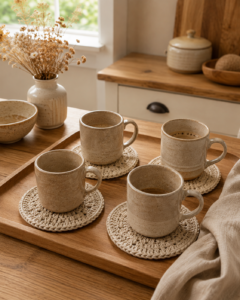
Crochet coasters can actually become part of your kitchen decor.
Try placing them:
Beside your coffee maker
Create a small coffee station with four matching coasters.
On a wooden tray
Layer crochet, wood and ceramic for a warm handmade look.
On the dining table
Arrange four or six coasters around the table before guests arrive.
Under a decorative vase
A large crochet coaster can work as a small decorative mat.
Beside a teapot
Use a coordinated set for afternoon tea.
On open shelving
Stack colorful coasters together so they become part of the display.
Crochet Coasters for Every Season
One of the best things about making your own coasters is that you can change them throughout the year.
Spring
Try:
- Flowers
- Bunnies
- Butterflies
- Pastel mandalas
Summer
Try:
- Strawberries
- Lemons
- Watermelons
- Oranges
- Bright flowers
Fall
Try:
- Pumpkins
- Sunflowers
- Leaves
- Acorns
- Rust-colored mandalas
Halloween
Try:
- Ghosts
- Bats
- Spiders
- Spiderwebs
- Black cats
Christmas
Try:
- Snowflakes
- Christmas trees
- Stars
- Holly
- Candy canes
This allows you to keep the same basic crochet techniques while continually creating new designs.
Crochet Coasters as Handmade Gifts
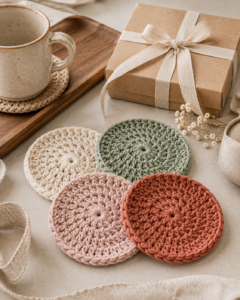
A set of four crochet coasters is an easy handmade gift that doesn’t require a huge amount of time or yarn.
Housewarming Gift
Make four neutral coasters in cream, beige and sage.
Coffee Lover Gift
Use brown, caramel and cream with coffee-inspired motifs.
Cat Lover Gift
Make four different cat faces.
Spring Gift
Use flowers and pastel colors.
Fall Gift
Combine pumpkins, leaves and sunflowers.
Christmas Gift
Create a matching set of snowflakes, trees and stars.
Tie the finished set together with ribbon or place it in a small gift box.
How to Make Your Coasters Look More Professional
The pattern is only one part of a polished finished project.
Keep the tension consistent
Try to maintain similar tension throughout the entire set.
Make every coaster the same size
If you are making four or six coasters, measure them as you go.
Use the same yarn weight
Even if the colors change, using the same yarn weight helps the pieces look coordinated.
Finish the edges carefully
A clean border makes a major difference.
Hide your yarn ends
Weave them securely into the back of the work.
Block when necessary
Blocking can help certain crochet designs lie flatter and look cleaner.
How to Wash Crochet Coasters
Always check the care instructions for your specific yarn.
For washable cotton yarn, a gentle wash is generally practical.
Basic care routine:
- Remove crumbs and loose debris.
- Wash according to the yarn label.
- Avoid unnecessarily high temperatures.
- Reshape the coaster while damp.
- Lay flat to dry when appropriate.
Do not automatically assume that every crochet coaster can be tumble dried.
The yarn’s care label should always be your first reference.
Crochet Coasters vs. Trivets
This is an important distinction.
A coaster is designed primarily for smaller items such as:
- Cups
- Glasses
- Mugs
- Small bowls
A trivet or potholder is designed for protecting surfaces from hotter cookware.
A crochet coaster should not automatically be considered heatproof.
If you’re placing a very hot pan or dish on your countertop, use a properly designed heat-resistant trivet or potholder made with suitable materials.
Beginner YouTube Crochet Coaster Tutorial
If you’re completely new to crochet, watching the stitches being demonstrated can make the process much easier.
A particularly useful beginner resource is Yarnspirations’ “Learn to Crochet: Minimalist Coasters.”
Watch the Yarnspirations beginner crochet coaster tutorial on YouTube
The tutorial covers fundamental techniques such as making a slip knot, holding the hook and yarn, creating a foundation chain, single crochet, crocheting in the round, half double crochet, joining with a slip stitch, fastening off and weaving in ends. It also demonstrates how to follow the project round by round.
How to use the tutorial
You don’t need to watch the entire video before starting.
Try this method:
Watch → Pause → Crochet → Check → Continue
If you’re struggling with one stitch, pause the video and repeat that section until the movement feels comfortable.
The tutorial is particularly useful for beginners because it demonstrates the techniques visually rather than expecting you to understand written abbreviations immediately.
A Second Crochet Coaster Tutorial to Explore
If you prefer a very simple single-crochet project, another useful option is The Crochet Architect’s beginner single crochet coaster tutorial, which demonstrates a basic coaster and several edging options.
Watch the beginner single crochet coaster tutorial on YouTube
This is especially useful if your goal is to learn how different borders can change the appearance of the same basic coaster.
Frequently Asked Questions
What is the best yarn for crochet coasters?
Cotton yarn is one of the most practical choices for everyday kitchen coasters because it is durable, available in many colors and commonly available in washable varieties.
How big should a crochet coaster be?
A standard coaster is usually around 4–5 inches in diameter, but the ideal size depends on the mug, cup or glass you want to place on it.
Are crochet coasters good for beginners?
Yes. Simple round coasters are excellent beginner projects because they use relatively little yarn and allow you to practice basic stitches, increases and working in rounds.
How long does it take to crochet a coaster?
The time depends on your experience, stitch pattern and coaster size. A simple design can be completed relatively quickly, while detailed mandalas or character designs take longer.
Can I use leftover yarn?
Absolutely. Crochet coasters are one of the best projects for using small amounts of leftover yarn.
Can I make crochet coasters in different shapes?
Yes. Circles are the easiest starting point, but you can also create squares, hexagons, hearts, flowers, fruit shapes, animals and seasonal designs.
Why is my crochet coaster curling?
Usually, a curling circular coaster needs more increases. Check your stitch count and make sure the increases are distributed evenly.
Why is my crochet coaster wavy?
Too many increases can cause the edge to ripple or become wavy. Check your pattern and stitch count.
Can crochet coasters be washed?
Many can, particularly those made with washable cotton yarn. Always follow the washing instructions for the specific yarn you used.
Can I sell crochet coasters?
Yes. Handmade crochet coasters can be sold individually or as coordinated sets. Themed collections, seasonal designs and personalized color combinations can make particularly attractive products.
Final Thoughts
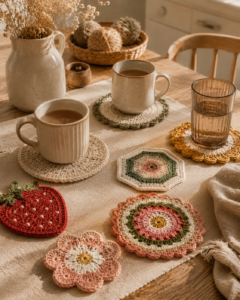
Crochet coasters may be small, but they offer almost endless possibilities.
You can take one simple circular pattern and completely transform it by changing the yarn colors, stitch texture, shape, border or decorative details.
Make a neutral set for a modern kitchen, colorful mandalas for a boho space, strawberries and flowers for a cottagecore kitchen, or pumpkins and ghosts for seasonal decorating.
They are also one of the best small projects for using leftover yarn, practicing new crochet stitches and creating handmade gifts without committing to a large project.
If you’re just starting out, begin with the simple round crochet coaster pattern in this guide. Once you are comfortable with increases and working in rounds, experiment with flowers, fruit, animals, mandalas and seasonal designs.
And don’t be afraid to mix different designs together.
A set doesn’t have to contain four identical coasters. Sometimes a carefully coordinated collection of different designs looks even more beautiful.
Which crochet coaster would you make first — a colorful mandala, a cute animal, a fruit-inspired design, or a classic round coaster?
1 thought on “27 Crochet Coaster Ideas, Patterns & Tutorials for a Beautiful Kitchen”